How much concrete do I need?
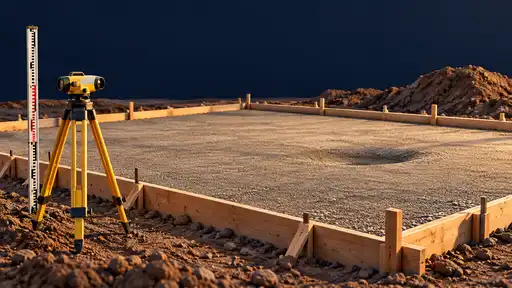
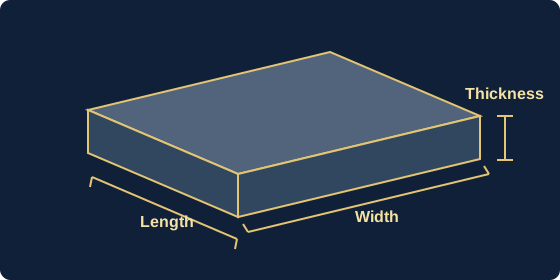
Measure each part of the pour and calculate its volume. A slab needs length, width, and thickness; a rectangular footing needs length, width, and depth. Add the volumes of separate sections before applying an allowance. Enter supplier pricing only if you have a current local quote. The output is a material volume estimate, not a structural design or a guaranteed delivery quantity. Bag concrete estimates use this same page. Divide the required mixed volume by the exact product yield and round up to whole bags; dry bag mass alone does not determine placed volume.
How do I measure a concrete slab’s length, width, and thickness?
For a rectangular slab, multiply length by width to find area, then multiply by thickness expressed in the same length unit. A 10 ft by 10 ft slab that is 4 in thick has 10 × 10 × (4 ÷ 12) = 33.333 ft³ of concrete before allowance. Divide cubic feet by 27 to convert to cubic yards. If the slab sits over a gravel base, estimate that separate layer with the gravel calculator.
How do I calculate concrete for rectangular footings?
Measure each continuous footing segment. Multiply its length by its actual width and depth, then add the segment volumes. If footing sizes differ, add another area in the calculator rather than averaging widths or depths. Plans, soil conditions, reinforcement, and local requirements determine the required footing dimensions; this calculator only measures the dimensions supplied. Estimate steel lengths separately with the rebar calculator when your approved design calls for reinforcement.
How do I calculate concrete for a round column or pier?
For a round column, volume equals π × (diameter ÷ 2)² × height. Enter diameter in feet and height in inches in the imperial setting, or diameter in meters and height in centimeters in the metric setting. The calculator converts units before adding the pier volume to any slabs or footings in the same estimate.
Volume = π × (diameter ÷ 2)² × height
Convert all dimensions to the same length unit first.
What formula converts concrete volume to cubic yards or meters?
For rectangular work in feet: cubic yards = length (ft) × width (ft) × thickness (in) ÷ 12 ÷ 27. For metric dimensions: cubic meters = length (m) × width (m) × thickness (cm) ÷ 100. One cubic yard equals exactly 0.764554857984 cubic meter. The calculator displays both units so you can check a supplier quote in its ordering unit. To compare other cubic measurements, see the cubic yard calculator.
Volume (ft³) = length (ft) × width (ft) × thickness (in) ÷ 12
Volume (yd³) = volume (ft³) ÷ 27
How many bags of concrete mix will I need?
Divide the order volume in cubic feet by the yield per bag and round up to a whole bag. QUIKRETE lists approximate yields of 0.30 ft³ for a 40 lb bag, 0.45 ft³ for a 60 lb bag, 0.60 ft³ for an 80 lb bag, and 0.675 ft³ for a 90 lb bag of its Concrete Mix. These figures are product specific: choose the custom yield setting if your mix label gives a different value. For a named bagged mix, you can also compare the Sakrete calculator; use the yield on your chosen product label.
| Bag size | Approximate yield |
|---|---|
| 40 lb | 0.30 ft³ |
| 60 lb | 0.45 ft³ |
| 80 lb | 0.60 ft³ |
| 90 lb | 0.675 ft³ |
What does a 10 × 10 ft concrete slab calculation look like?
At a 4 in thickness, the measured volume is 33.333 ft³ or about 1.235 yd³. With a 5% allowance, the order estimate becomes 35 ft³ or about 1.296 yd³. At an approximate yield of 0.60 ft³ per 80 lb bag, 35 ÷ 0.60 = 58.33, so the bag estimate rounds up to 59 bags. Check practical handling and whether a ready-mix delivery suits the job.
How do uneven ground and extra allowance affect the estimate?
Keep measured volume separate from any extra allowance. Excavation irregularities, form movement, spillage, and overdepth can change the quantity placed. The percentage field multiplies the calculated volume; it does not measure site variations for you. Confirm the pour dimensions on site and ask the supplier how it prices and delivers partial cubic yards.
Should I use bagged concrete or order ready-mix?
Bag count is based on the yield of a chosen bagged product. Bulk ready-mix is normally ordered by delivered volume; use the cubic-yard or cubic-meter output for a supplier conversation. Bag size alone is not enough to calculate yield accurately across every mix. Pricing in this tool is optional, uses your entered price per cubic yard, and excludes delivery, labor, pumping, reinforcement, and tax.
What should I check before placing a concrete order?
Measure the final forms and excavation, confirm all units and design dimensions, and compare bag yield with the product label. For structural footings, columns, or slabs carrying loads, follow the approved design and local professional guidance. For separate masonry supplies, see the cement, rebar, and concrete weight tools in the concrete and masonry directory.