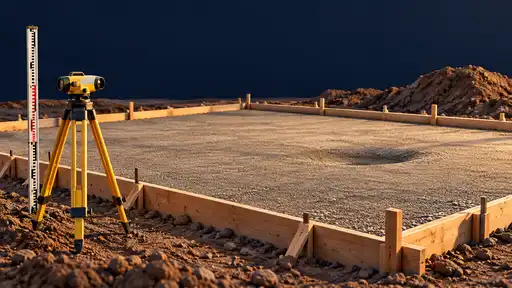
When a truck cannot reach the pour, compare on-site batching with short-load concrete delivery by checking the full transfer route, crew capacity, product yield, placement continuity and total quoted cost. Truck access is only one part of the decision. The selected method must also meet the project’s concrete specification and the planned placement requirements.
Define the two methods and the required concrete
On-site batching can mean mixing a packaged product at the site or using specialized batching equipment. A short-load delivery brings a smaller ordered quantity of ready-mixed concrete, subject to the supplier’s minimums and terms. Ask the supplier to describe the actual service rather than comparing labels alone. Neither method automatically resolves a narrow gate, a long carry route or an inaccessible placement point.
Keep the required concrete specification separate from the logistics choice. A bag calculation establishes a quantity for a verified product yield; it does not establish that the product is suitable for a structural element or that a proposed mixing and placing method meets the design. Give the engineer or responsible designer the planned supply method where their approval is required. Do not substitute an improvised cement recipe to solve an access problem.
Check the supported bag scenario with the Sakrete Calculator.
Short-load concrete tradeoff: the entire access and transfer route
Draw the unloading or mixing point, the final pour location and the route between them. Record the narrowest gate, turns, steps, slopes, overhead restrictions and surfaces that may need protection. Identify whether each proposal uses a chute, barrows, a pump or another transfer method. Ask the delivery and placement contractors to assess the real route and confirm equipment clearances and safe operating arrangements.
Use photographs and measured dimensions instead of a description such as easy access. A truck stopping at the kerb still leaves a transfer job to organize. Conversely, delivering dry bags close to the mixer may reduce one handling stage but leave others. Mark where water, power and clean-up access are available, and check whether the planned staging area conflicts with pedestrian routes or neighbouring property.
Tradeoff two: batching and placement capacity
Write down who mixes, who transfers and who places and finishes the concrete. Those jobs need to form a workable sequence. Ask the contractor to estimate output for the selected equipment and crew under the actual route conditions, with their basis stated. A catalogue mixer capacity does not equal verified production at the forms, particularly when loading, discharge and travel share the same workers.
For delivery, request the supplier’s arrival window and charging terms, then coordinate them with the transfer and finishing crew. For on-site batching, identify where unopened bags are stored and how batches are recorded. Avoid inventing a universal number of bags per hour. A witnessed trial with the actual crew and equipment can support a planning estimate, but label it as a trial rather than claiming it guarantees the whole placement.
Tradeoff three: measured volume and product-specific bag yield
Measure the formed placement after preparation and keep length, width and depth in compatible units. The published Sakrete Calculator covers slab or round-form quantities using Sakrete 5000 Plus yields. Its bag result applies to that product and package basis. If the specified concrete is different, verify the appropriate manufacturer yield or supplier order basis instead of transferring the same bag number.
For a hypothetical 10 ft by 8 ft rectangular placement at a uniform assumed depth of 4 in, convert depth to 4/12 ft. Volume is 10 × 8 × (4/12) = 26.6667 ft³. Dividing by 27 gives approximately 0.9877 yd³. The metric check uses 3.048 m × 2.4384 m × 0.1016 m, which gives approximately 0.7551 m³. These dimensions illustrate quantity arithmetic and do not specify a suitable slab thickness.
Sakrete’s published 5000 Plus product information gives 0.60 ft³ per 80 lb bag. For this example, 26.6667 ÷ 0.60 = 44.4445 bags, so the minimum whole-bag purchase is 45 before any separately justified allowance. Keep the unrounded volume until the final purchase-unit step. The same volume with another package or product needs its own verified yield. Dry bag mass and finished concrete volume are different quantities.
Read Sakrete 5000 Plus package sizes and published yields.
Record allowances without counting them twice
Record any allowance separately from the measured volume and identify its basis. Uneven preparation, spillage and uncertain dimensions should be investigated or explicitly assessed; they do not justify a universal extra percentage. If the supplier’s order already includes an agreed quantity adjustment, do not add it again in the calculator. Save the measured inputs, allowance and whole purchase units together so that the final order remains traceable.
Keep the measured inputs and allowance separate in the Sakrete Calculator.
Tradeoff four: consistency and placement continuity
The supply plan needs to preserve the selected product instructions and project requirements throughout placement. For packaged material, keep the mixing instructions, water measurement and batch identification available to the crew. For delivered material, agree the specification and any authorized adjustments with the supplier. Do not use extra water as a general solution to a difficult route or a delayed transfer. Ask the responsible contractor how they will handle an interruption.
Discuss the sequence and any planned construction joints with the designer or contractor responsible for the work. A calculator cannot determine whether an unplanned pause is acceptable. Check whether enough workers and equipment are available to receive, transfer, place and finish the supplied quantity. If the method depends on perfect timing with no confirmed fallback, resolve that risk before releasing the order.
Tradeoff five: the complete quoted cost
Compare quotations for the same accepted concrete quantity and specification. For bag batching, include product, delivery, handling, mixer hire, required services, labour, protection and clean-up. For short-load delivery, ask about minimum load charges, access or pumping costs, waiting charges and the order-change policy. Record quote dates, tax treatment and exclusions in the local currency. A low material price does not establish a low installed cost.
Use the equation total comparable cost = material + delivery + transfer equipment + labour + preparation + agreed charges + clean-up. Enter actual current quotations for each term. If a term is included in another charge, mark it as included rather than adding a guessed duplicate. In the USA, keep cubic yards and US package sizes explicit. In the UK or another European country, use that market’s quoted cubic metres and verified package yield.
Reconcile the order before the placement day
Send the accepted route sketch, concrete specification, measured quantity and agreed crew sequence to the responsible contractors. Confirm the method each quote actually supplies and resolve any product or design approval. Use the Sakrete Calculator to check the supported bag scenario again after measurement changes, and compare the final inputs with the supplier order. Retain the batch or delivery records with the project quantities.
Before buying, check the final measured slab or round-form inputs in the Sakrete Calculator. Treat its result as a quantity estimate for the supported product, then confirm the whole order, handling plan and placement requirements with the supplier and contractor.
Review the final supported product quantity in the Sakrete Calculator.
Check that the supplier quote and the quantity worksheet refer to the same pour boundaries. A revised edge, thicker local section or changed form can alter the order after an earlier comparison. Give each revision an identifiable date or drawing reference. Do not hide that change in a rounded bag number, and do not treat a previously agreed delivery quantity as evidence that the final prepared geometry has been measured.
| Quantity | Value | Basis |
|---|---|---|
| Placement volume | 26.6667 ft³ | Hypothetical measured geometry |
| Yield per bag | 0.60 ft³ | Sakrete 5000 Plus, 80 lb |
| Whole bags | 45 | Round up after division; no extra allowance |
- Confirm the full unloading-to-pour route.
- Compare the same specification and accepted volume.
- Retain the product yield, allowance basis and quoted charges.