What does this duct calculator calculate?
Size a duct from airflow and target velocity, check an existing round or rectangular duct, and calculate pressure loss from entered coefficients.
Which measurements do you need?
Choose sizing to derive cross-sectional area from airflow and target velocity. Choose checking to calculate velocity in an existing inside diameter or rectangular opening.
| Input | Use |
|---|---|
| Airflow in selected flow unit | Measured or specified project value |
| Target velocity | Measured or specified project value |
| Rectangular width / height ratio | Measured or specified project value |
| Inside round diameter | Measured or specified project value |
| Inside rectangular width | Measured or specified project value |
| Inside rectangular height | Measured or specified project value |
| Straight duct length | Measured or specified project value |
| Darcy friction factor (optional) | Optional supplied value |
| Air density (kg/m³, optional) | Optional supplied value |
| Total fitting loss coefficient K (optional) | Optional supplied value |
Which formula produces the result?
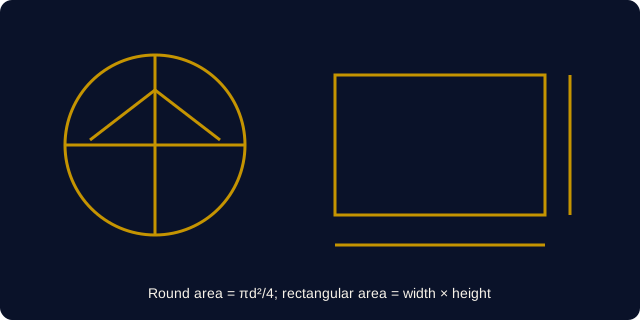
Area = airflow ÷ velocity; round diameter = √(4 × area / π); pressure loss = (f × length / hydraulic diameter + K) × density × velocity² / 2
How does a worked example look?
At 400 CFM and 600 ft/min, required area is 0.667 sq ft and a velocity-equivalent round diameter is about 11.06 in.
How should you enter units?
Select metric or imperial before entering dimensions. Switching units converts entered measurement fields; prices and dimensionless percentages keep their values.
Which assumptions affect this estimate?
The sizing result reports both a circular diameter and a rectangular width and height at your chosen aspect ratio. Neither result automatically rounds to an available manufactured size.
How should you interpret rounding?
Pressure loss uses Darcy friction factor, straight length, air density and the total fitting loss coefficient K you supply. A Fanning friction factor must be multiplied by four before it is used as Darcy f.
Which project details need another check?
In sizing mode, pressure is calculated along the round equivalent path. For a rectangular pressure estimate, use checking mode with rectangular dimensions; hydraulic diameter is 2ab/(a+b).
How can you compare scenarios?
Calculate a baseline, add it to compare, then change one input and calculate again. The comparison keeps input and result snapshots so you can identify what changed.
Which tools can help with the next step?
Use the HVAC & Climate Control tool directory for related calculations. Keep the scope and units consistent when moving between tools.